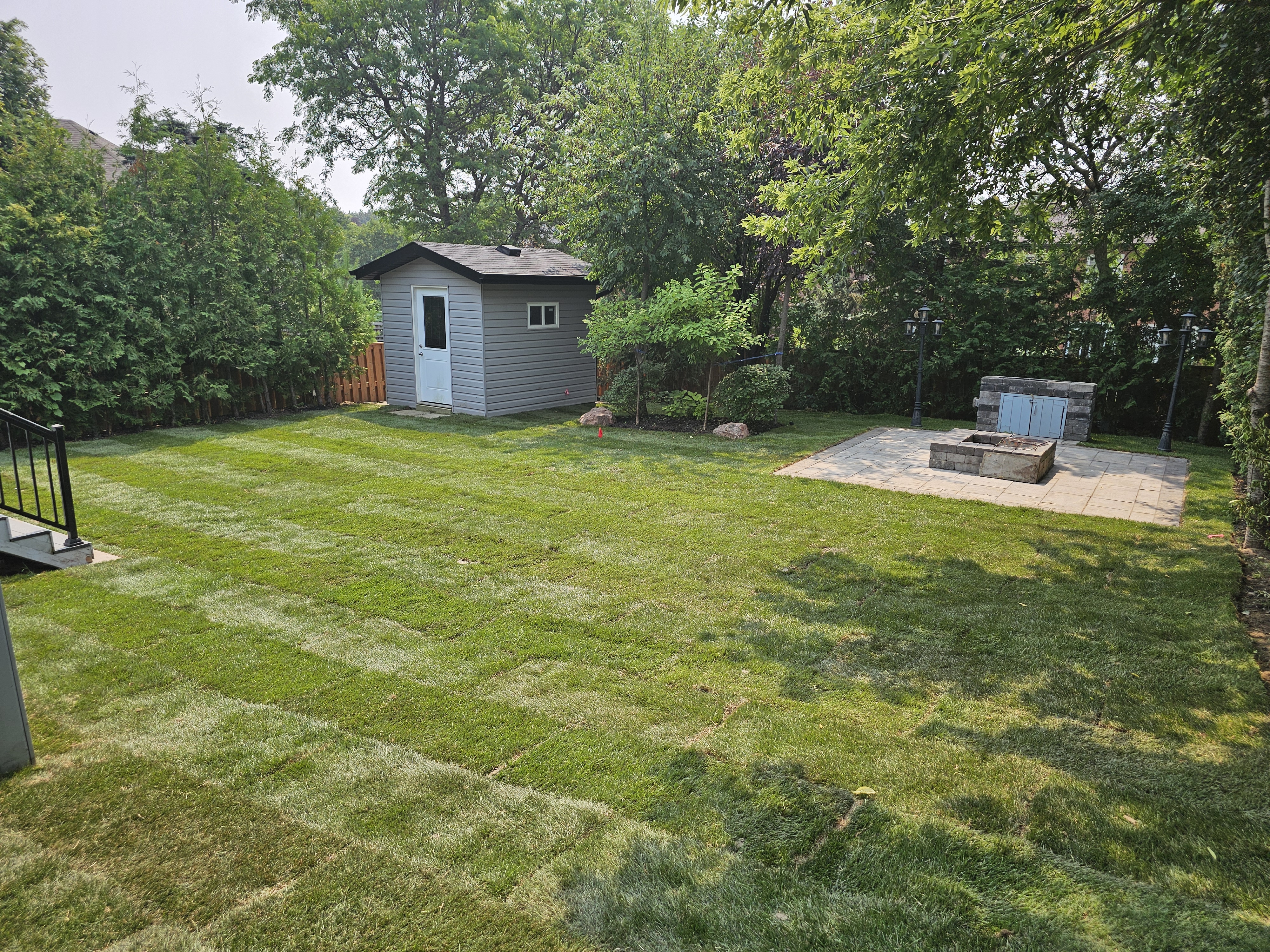
No — sod should not be laid tight against a mature tree’s trunk. Leave a gap around the trunk (mulch or bare soil works better there than turf) so the root flare, where the trunk widens out into its main roots, stays uncovered. Expect a thinner strip of grass or a bare ring directly under a dense canopy rather than a uniform lawn edge-to-edge — that’s a light and root-competition issue, not a sign the installation was done badly. The bigger risk to the tree usually isn’t the sod itself, it’s disturbing or piling soil over its structural roots while grading for it.
Mature trees are one of the best features a GTA property can have — shade in summer, real value on a listing, decades of growth you can’t buy back. Sodding around one without hurting it just takes a different approach than an open, sunny yard. Here’s what actually matters.
Why Can Digging or Grading Near a Mature Tree’s Roots Hurt the Tree?
A mature tree’s structural roots — the ones holding it upright and moving most of its water — sit mostly in the top 12-18 inches of soil, often spreading out well beyond the edge of the canopy rather than staying directly underneath it. Cutting through several of these roots to level a yard, or compacting the soil above them with equipment, can stress or destabilize a tree that took decades to grow. This is why we hand-dig and hand-grade close to a trunk instead of running a sod cutter or plate compactor through that zone — it’s slower, but it’s the difference between a healthy tree and one that declines over the next few seasons.
Do Tree Roots and New Sod Compete for Water and Nutrients?
Yes. A large tree’s root system is far more established than a freshly laid strip of sod and will out-compete it for both water and nutrients in the same soil profile, especially in the first few weeks while the sod’s own roots are still shallow. That’s part of why grass directly under a big canopy often stays thinner even with a perfect installation and a normal watering schedule — the tree is simply better at pulling from that soil than new sod is. Extra watering doesn’t fix this; it just risks overwatering the area, which can lead to its own rot or mushy-soil problems.
How Do You Grade Around a Root Flare Without Burying It?
The root flare should stay visible after grading is done — if you can’t see where the trunk widens into its roots anymore, there’s too much soil piled against it. We grade by hand near the base of the tree, tapering the topsoil down to meet the existing grade at the flare rather than building it up evenly across the whole yard the way we would on an open lawn area. The same soil-depth and grading principles from our soil preparation guide still apply everywhere else in the yard — trees just mean the last few feet around the trunk get handled differently.
Is There Enough Light Under the Canopy for Sod to Survive?
Sometimes, and sometimes not — it depends on how dense the canopy is and how many hours of direct sun still reach the ground. Our Kentucky Bluegrass sod needs at least 4-6 hours of direct sunlight a day to stay thick; under a full, mature canopy that filters most of the light, that threshold often isn’t met no matter how well the soil and roots are handled. We cover this in more depth, including what the options are for a yard that’s too shaded to hold a standard lawn, in our shade guide.
Our Approach to Sodding a Yard With Mature Trees You Want to Keep
When we quote a property with mature trees on it — common on older, established streets across Toronto, North York and the rest of the GTA — we look at the same things every time: how much of the lawn area actually gets direct sun once the canopy is accounted for, roughly where the structural roots are likely running near the surface, whether the existing grade already sits too high or too low against the root flare, and whether the tree looks healthy enough that regrading nearby is a reasonable thing to do at all. We’ll tell you honestly if a spot under a tree isn’t a good candidate for a uniform lawn, the same policy we use for shaded yards generally — it’s a better outcome than sod that struggles for one summer and needs redoing.
If you’ve got mature trees on the property and want an honest read on what will and won’t hold sod, get a free quote and we’ll walk the yard with you before anything is ordered.
Got a Mature Tree You Want to Keep?
We’ll check the roots, the grade and the light on-site and give you an honest answer before you order sod — free quote in 24 hours.