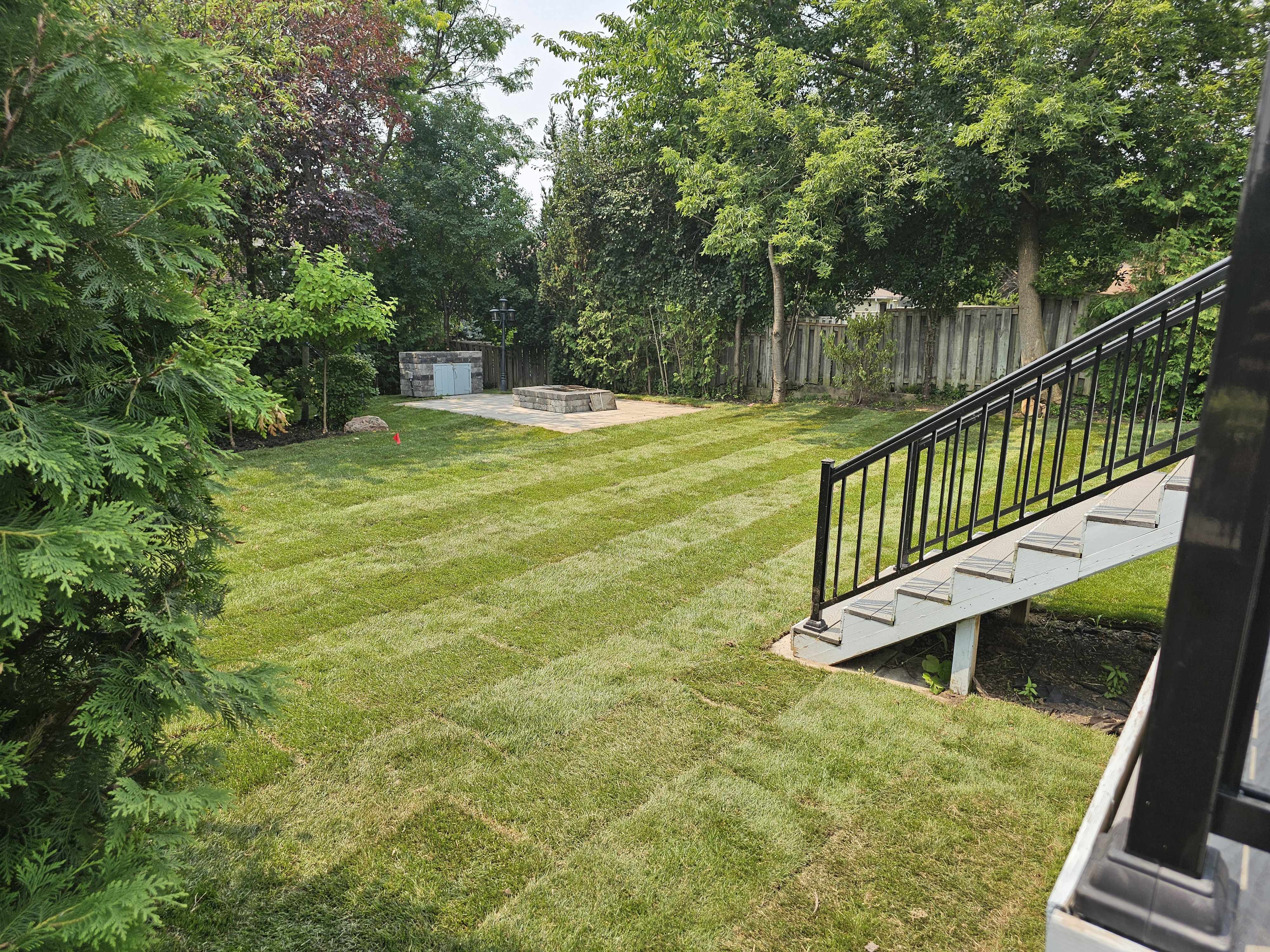
For most Ontario lawns, the best sod is a Kentucky Bluegrass blend — the “Ontario No. 1” standard grown by virtually every local sod farm. Fescue blends win in two specific situations: heavy shade under mature trees, and properties where you want to water and fuss as little as possible. That’s the short answer. Here’s why it shakes out that way, and how to pick the right roll for your particular yard.
Why Kentucky Bluegrass dominates Ontario sod farms
Drive past any sod farm in Southern Ontario and you’re almost certainly looking at Kentucky Bluegrass. That’s not habit — it’s because KBG is genuinely built for this climate and for the way sod itself works:
- It’s cold-hardy. KBG is a cool-season grass that shrugs off Ontario winters. It goes dormant under the snow and comes back thick in spring, year after year.
- It repairs itself. KBG spreads by underground stems called rhizomes. When a patch gets damaged — a dog spot, a dropped patio stone, a rough winter — the surrounding grass creeps in and fills the gap on its own. Most fescues grow in bunches and can’t do that; a bare spot stays bare until you reseed it.
- It knits into sod. Those same rhizomes are what let a farm cut KBG into rolls that hold together. It’s the reason bluegrass is the sod crop here.
- It looks the part. Deep blue-green colour, fine texture, and it takes a stripe beautifully. When people picture a perfect lawn, they’re picturing Kentucky Bluegrass.
Where fescue makes sense
Fescue isn’t second-rate grass — it’s different grass for different conditions. There are two families to know: fine fescues, which are the most shade-tolerant lawn grasses we can grow in Ontario, and tall fescue, which sends roots down deep and rides out dry spells better than almost anything else. Reach for a fescue-heavy blend when:
- Your yard sits in real shade. Under mature maples and oaks, KBG thins out and gives up — it wants six-plus hours of sun. Fine fescue stays respectable on three or four.
- You want a low-water lawn. Tall fescue’s deep roots find moisture KBG can’t reach, so it stays green longer into a dry August without irrigation.
- You want lower maintenance overall. Fescues generally ask for less fertilizer and less pampering. The trade-off is a slightly less refined look and no self-repair.
Kentucky Bluegrass vs Fescue at a glance
| Kentucky Bluegrass blend | Fescue blend | |
|---|---|---|
| Appearance | Deep blue-green, fine texture — the classic showpiece lawn | Medium to darker green, slightly coarser (tall fescue) or very fine (fine fescue) |
| Shade tolerance | Fair — wants 6+ hours of sun | Excellent — fine fescue handles 3–4 hours |
| Water needs | Higher — likes regular deep watering | Lower — tall fescue’s deep roots ride out dry spells |
| Wear recovery | Excellent — rhizomes fill in damage on their own | Limited — bunch growth means bare spots need reseeding |
| Best for | Sunny yards, kids and dogs, homeowners who want the showpiece lawn | Shady yards, low-water properties, hands-off homeowners |
What “Ontario No. 1 sod” actually means
When you see a quote for Ontario No. 1 Kentucky Bluegrass sod, that’s not marketing fluff — it’s a grading standard local farms grow to. To make the grade, sod has to be dense and uniform, essentially weed-free, mature enough to hold together as a roll, and cut with a consistent thickness of soil and healthy root. It’s typically a blend of two or more improved bluegrass varieties, which protects the lawn: if disease or a rough season hits one variety hard, the others carry it. If a price seems too good to be true, ask what grade the sod is — ungraded or overgrown sod is where cheap installs go wrong.
Fresh local sod beats trucked-in sod, every time
Sod is a living plant sliced away from its roots — the clock starts the moment it’s cut. Rolled up on a pallet, it heats up from the inside and starts to yellow within a day or two, faster in summer. That’s why we pick up from local Ontario farms and lay the sod the same day it’s cut. Sod trucked in from hours away, or left sitting on a pallet since last week, is fighting for its life before it ever touches your soil. The variety on the label matters less than how fresh the roll is when it hits the ground — the best sod for Ontario is, first and foremost, sod that was growing in Ontario dirt that same morning.
Quick buyer’s guide by yard type
- Full-sun front yard: Ontario No. 1 Kentucky Bluegrass, no hesitation. This is exactly what it was bred for — maximum curb appeal, self-repairing, thrives in open sun.
- Tree-covered backyard: a fescue-heavy shade blend. KBG will slowly starve under a dense canopy no matter how well it’s installed; fine fescue is the honest choice there.
- Kids and dogs: Kentucky Bluegrass. It takes the abuse and — more importantly — heals the abuse. Rhizomes fill in worn goal-mouths and dog runs that would stay bare in a fescue lawn.
The bottom line
Start with Ontario No. 1 Kentucky Bluegrass and only deviate for a reason — deep shade or a strict low-water goal, where fescue earns its keep. Whatever you choose, insist on fresh-cut sod from a local farm and proper soil prep underneath it; those two things decide the result more than the seed variety ever will. Curious what your lawn would cost? Check our sod pricing calculator, see how we work in Mississauga, and once it’s down, follow the new-sod care guide to get it rooted.
Whether your lawn is in Toronto, Vaughan, Markham, Richmond Hill, North York or Brampton, the process is the same and so is the guarantee.
Get the Right Sod for Your Yard
Fresh-cut Ontario No. 1 sod, matched to your sun, shade, and family — installed in a day.
Get Your Free EstimateOr call us now: (416) 639-1794